Elead CRM is one of the few CRMs where the first question is not “which plan?” but “are you a CDK dealership?” Elead is an automotive retail CRM built for franchise dealerships, and it is tightly connected to CDK Global’s dealership management system. That makes it a strong fit for a certain kind of store and a poor fit for almost everyone else.
The product is often searched as “Eleads CRM,” and the plural is understandable; the brand has been in dealer software for years and the product line spans sales, BDC, service, and customer engagement. But the buying decision is not a generic CRM comparison. It is a dealership operations decision, with a contract that is usually negotiated rather than published.
What Elead CRM is
Elead is a dealership CRM. Its job is to keep the customer conversation visible from the first internet lead through the showroom visit, the finance office, delivery, and the next service appointment. The system is designed around automotive workflows: lead sources, BDC follow-up, appointment setting, showroom logs, desking, F&I handoffs, and service retention.
Because Elead is part of CDK Global, the integration story is closely tied to the CDK ecosystem. For a dealer already running CDK’s DMS, that can reduce duplicate entry and make customer, vehicle, and deal data easier to see in one place. For a dealer on a different DMS, the value proposition is weaker and the integration work may be more expensive than the demo suggests.
This is not a CRM you buy for a 10-person B2B sales team. It is not priced like one, and it is not configured like one. The workflows assume a dealership: ups, appointments, showroom traffic, trade-in conversations, lender approvals, and service visits.
The dealership handoff is the product
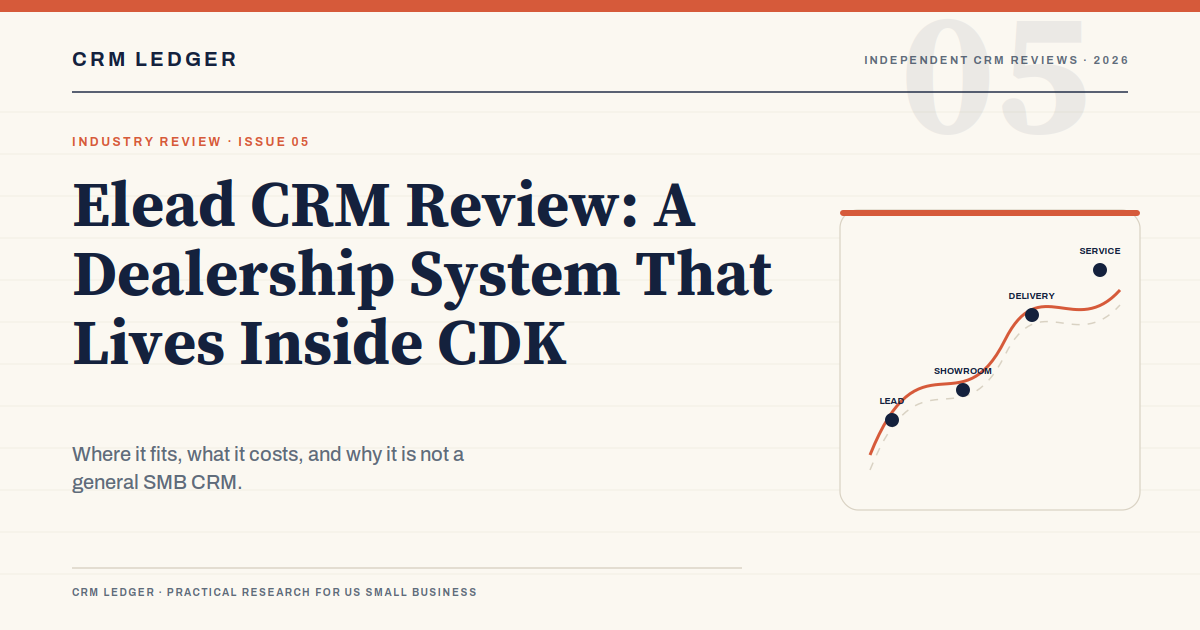
Most dealership CRM problems are handoff problems. An internet lead goes to the BDC, the BDC sets an appointment, the salesperson works the showroom visit, the desk quotes the deal, F&I presents products, the customer takes delivery, and service owns the relationship after that. If any one of those handoffs is invisible, the customer gets asked the same question twice and the store loses the thread.
What Elead does well
Automotive-specific workflows. A generic CRM can be configured to look like a dealership, but it will still lack the assumptions that matter: ups, appointments, showroom logs, trade-in conversations, desking, and service retention. Elead starts from those assumptions.
CDK integration. For a CDK dealership, the integration can reduce duplicate entry between the DMS and the CRM. Vehicle, customer, and deal data can be visible in one place, which is the difference between a CRM that saves time and one that creates a second database.
BDC accountability. The BDC is a measurable operation: speed to lead, contact attempts, appointment set rate, show rate, and sold rate. Elead’s workflow is designed around those measures. A manager can see who worked a lead and what happened next.
Multi-rooftop visibility. Dealer groups need to compare stores without forcing every store into an identical process. Elead is built for the group context, including reporting across rooftops and centralized follow-up standards.
Service and equity mining. The sale is not the end of the relationship. A dealership CRM that connects service history and vehicle ownership data can surface customers who are likely to return for service or trade. That is a different value proposition from a B2B CRM’s renewal management.
What to watch before you sign
Pricing is not published. Elead is quoted through CDK, and the price is often bundled with a DMS contract or other CDK products. That makes comparison shopping difficult. Ask for an itemized quote that separates CRM seats, implementation, training, integrations, and any third-party vendor fees. Industry benchmarks for automotive CRM can run from roughly $500 to $3,000 per rooftop per month depending on modules, but your quote will depend on the store count, contract length, and bundle.
CDK dependency cuts both ways. If you are on CDK, the integration is the reason to look. If you are not, the integration may require a migration or an expensive connector. Be explicit about which systems are in scope and who pays for the connection.
Vendor integration fees. Dealership software ecosystems often include fees for third-party vendors to connect. Those fees can affect which lead sources, desking tools, or service products you can use. Ask for the list of approved integrations and the cost of adding one that is not on it.
Implementation and training. A dealership CRM touches the BDC, sales floor, desk, F&I, and service. That is a lot of process change. Ask who trains each department, how long the on-site support lasts, and what happens after the launch week.
Reporting that matches the store. Dealership reporting has its own vocabulary: ups, shows, writes, gross, penetration, CSI, and service retention. Make sure the reports your managers use are available without a custom build. A generic dashboard will not satisfy a dealer principal who wants to compare stores.
Data ownership and exit. Ask how customer records, deal history, notes, and attachments are exported. Ask what happens to the data if the CDK contract ends. A CRM is a system of record; the dealer should own the record.
How to evaluate Elead without a generic demo
Ask for a demo built around your own rooftop, not a generic store. Give the vendor three real lead scenarios: an internet lead that goes cold, an appointment that shows and buys, and a service customer with equity in a vehicle. Then ask each department to run its part of the workflow in the demo.
The questions that matter:
- Which lead sources connect natively, and which require a third-party vendor fee?
- How does the BDC see appointment attempts, show status, and next follow-up?
- What does the salesperson see when the customer arrives, and what is required before the ups sheet closes?
- How does the deal move from desking to F&I, and where are the handoff notes kept?
- How is service history attached to the customer and vehicle record?
- What reports can a dealer principal run across rooftops without a custom build?
- What is the implementation timeline by department, and who trains each one?
- What are the contract term, renewal, and price escalation terms?
- How do we export customer, deal, and service data if we leave?
- Which CDK products are included, and which are separate line items?
If the vendor cannot answer the integration-fee question clearly, treat that as a red flag. The fee may be legitimate, but it should be visible before you sign, not after you have already moved the BDC onto the system.
Who should choose Elead, and who should not
Choose Elead if you are a franchise dealership or dealer group on CDK, you have a BDC or a structured lead process, and you need sales, service, and retention data connected. The integration and the automotive workflow are the reasons to pay for a specialized system.
Do not choose Elead if you are an independent business with a general sales pipeline, a non-CDK dealership without a clear integration plan, or a small store that cannot support the implementation and training load. A simpler automotive CRM or a general small-business CRM may be a better financial decision.
It is also worth comparing the alternatives that serve your DMS. VinSolutions, DealerSocket, Reynolds & Reynolds, and Tekion all compete for dealership CRM budgets. The right shortlist depends on your DMS, your store count, and the workflows you refuse to change.
Frequently asked questions
Is Elead CRM the same as CDK CRM?
Elead is part of CDK Global’s automotive software portfolio, and it is often sold alongside CDK’s DMS and retail products. The exact packaging and product names can vary by contract, so ask the vendor to define what is included in your quote.
How much does Elead CRM cost?
Elead does not publish list pricing. Costs are quoted per dealership and are often bundled with other CDK products. Industry benchmarks for automotive CRM can range from several hundred to a few thousand dollars per rooftop per month, depending on modules and contract terms. Ask for an itemized quote.
Is Elead good for a small used-car lot?
It can be, if the lot has enough lead volume and a structured follow-up process to justify the system. A smaller independent store with a simple pipeline may be better served by a lower-cost automotive CRM or a general small-business CRM.
The bottom line
Elead CRM is a specialized tool for a specialized business. If you run a CDK dealership, the integration and dealership workflows can make it the obvious choice. If you do not, the product’s cost and complexity are hard to justify. Judge it on the handoffs it makes visible, the fees it adds, and the data you can take with you. The name on the CRM matters less than whether the BDC, sales floor, F&I office, and service drive can all work from the same customer record.